Tuesday, November 12, 2013

Tartine Country Bread

Hope you guys are ready for a chatty intro!

I have a borderline obsessive relationship with fresh baker's yeast. I'm the weirdo who sniffs (and enjoys) packs of fresh yeast; breweries and bakeries fumes are my friends. And occasionally, I've been known to enjoy the wafts of growing yeast cultures in my lab (I'm a biologist and lucky for me, I've always had a bench close to the incubators).

Naturally, I've always wanted to bake my own bread. But I've never been successful at baking good looking (or tasting) bread, to my utter despair.

A few weeks ago, an innocent conversation with a colleague J. sparked my interest in the Tartine Country Bread, a no-knead recipe baked in a special cast iron dish. Of course, the minute we were done talking, I raced to my computer and ordered myself my very first Lodge cast iron combo cooker. The added benefit of which is that I've also been lusting after a cast iron skillet for over a year. I figured this was just meant to be.

That very same night, I also started a sourdough starter culture, but after a few days, I was perplexed by the foul smell that escaped from my little mason jar (and I work in a lab if you remember, so I'm pretty used to nasty smells), so I just discarded my own starter. Bummed as ever. My awesome colleague J. was kind enough to split her own starter culture with me, and I excitedly proceeded to my baking experiment!

Here is how I did it.


INGREDIENTS (for 2 loaves):
- 700g +50g tepid water
- 900g AP flour
- 100g whole wheat flour
- 200g sourdough over-night culture (recipe coming up soon)
- 1 tbsp salt
- a cast iron pot with a lid (I use a Lodge combo cooker)


RECIPE:
- in a large bowl, mix the two flours, the sourdough and the 700g water. Using your hands, mix until combined and the dough is super sticky

- let rest for 40 minutes, in a warm place covered with a clean cloth (I put mine on top of the stove, since the pilot flames keep it warm; otherwise a closed oven or microwave provide warm drought-free environments too)

- after 40 minutes, add 50g of tepid water and the salt, and mix the dough with your pre-wet hand. At first, the dough will be soft and squishy, but will turn harder, springy and very stretchy after a few minutes

- when the dough is stretchy, fold it four times starting on the right: lift the dough from the bottom, stretch it upwards, fold it towards the left and press it down the middle. Do this on all four "corners": right, top, left, bottom. Cover the dough with a cloth and let rest in a warm spot and repeat the 4 turns every 30 minutes for 3.5 hours. This step is the bulk fermentation.

- at the end of the bulk fermentation step, the dough will have risen a little bit, and if your container is clear, you can even see bubbles on the sides, which is a good sign your dough is very much alive!

- drop the dough on a clean surface (not floured!) and sprinkle the top the the dough with a little AP flour. Using a dough scraper, cut in half and flip the two halves upside down so that the floured surface is down and the sticky surface is up. Fold all four corners of the dough back towards the center. The sticky dough should seal on itself and leave only floured surface exposed. Flip again, shape into a ball, cover with a cloth and let rest for 20 minutes.

- after the dough has rested 20 minutes, sprinkle with AP flour, flip using a dough scraper and proceed to folding the dough, from all four corners, flip again and shape into a ball. Repeat for the second piece.


- once your dough has been folded and shaped into a ball, place delicately in a bowl or basket, lined with a heavily floured cloth and let rest for 2 hours minimum in a warm spot

- about 1 hour before you are ready to bake your first loaf, preheat your oven at 500F and place the cast iron pot in the oven so that it gets to temperature
- when you are ready to bake, delicately drop one of the dough balls in the pot (if you are using the combo cooker, that would be the skillet), score the dough with a sharp knife or blade, cover and bake at 450F for 20 minutes

- after 20 minutes, remove the lid and bake uncovered for another 20-25 minutes. Your bread should be beautifully golden and crispy! Transfer on a cooling rack and repeat with the other loaf

- Enjoy your bread, and take a moment to congratulate yourself! ;)


Sunday, November 10, 2013

Butternut squash, Kale and Pancetta soup

Nothing I like more than a comforting, warming, delicious chunky soup this time of year.

It makes use of seasonal vegetables (squash and kale) and I love the flavor combo of smokey, salty pancetta and creamy cannellini beans. This recipe can also be kept vegetarian by switching chicken stock to vegetable stock. For a vegan option, I would substitute butter for olive oil, and pancetta with a teaspoon of miso or half a teaspoon of marmite.

Try this soup, you will love it!

INGREDIENTS (for 6 people):
- 1 medium butternut squash, peeled, seeded and diced relatively finely (about 1/4 inch cubes)
- 1 can of cannellini beans, drained and rinsed
- 1 bunch of kale, remove the stalks and grossly chopped
- 1 cup onion, diced finely (1 medium onion should do)
- 1 cup carrots, diced finely
- 1 cup celery, diced finely
- 4 oz cubed pancetta
- 1 sprig of fresh thyme (dry works fine too)
- 2 tbsp butter
- 12 cups liquid (I used 8 cups chicken stock and 4 cups water)

RECIPE:
- in a deep stockpot, melt the butter and fry the pancetta over medium-high heat until crispy and golden
- add the carrots, celery and onion (this flavor base is also called a mirepoix) and the sprig of thyme.  Cook over medium heat until the vegetables are soft and the pancetta drippings have been deglazed from the bottom of the pan (about 5 minutes)
- after 5 minutes, add the cubed squash, stock and water and bring to a boil. When the liquid boils, lower heat to medium-low and simmer for about 20 minutes, or until the squash is almost cooked through
- add the kale and beans, and cook for another 5-10 minutes, or until the kale is cooked to your taste
- Enjoy!

Tuesday, November 5, 2013

Gratinee a l'oignon (French Onion soup)

One of the perks of cold weather is that it is once again the season to enjoy the deliciousness that is French onion soup.

An absolute classic recipe that is best enjoyed after a day of skiing, hiking or really just plain lazy urban cocooning, it is one of the cheapest and satisfying meals I can think of!

Do try it. I promise you this will not be in vain :)

PS: on top of my regular point and shoot photography, my friend Rod came over to share some food and macro photography tips. Take a look at this!

Photographs by Rod Egret

INGREDIENTS (for 4 people, or 2 people for 2 meals)
- 1 1/2 lbs onions
- 2 large cloves of garlic
- 1/3 cup AP flour
- 1 cup white wine (I used Pinot Grigio, but you can use Riesling or even a red; if you are using a white though, use a dry wine not sweet)
- 8 cups beef broth (you can use vegetable broth if you wish to make a vegetarian version, but if you do eat meat, beef is the way to go!)
- 1/2 stick of butter
- a sprig of thyme and a bay leaf
- a stale French baguette, or any stale bread you can slice and shape into large croutons
- PLENTY of grated Alpine Gruyere (No, you really cannot use mozzarella, jack or cheddar on this... If you cannot find Gruyere, I guess an aged Parmesan would work, but you just cannot replicate the sweet, nutty, delicious flavor of Gruyere. It is really not that much of a splurge: I got the pictured slab for about 5.50 dollars at whole foods, and only used about half of it. For real!)


RECIPE:
- in a dutch oven or deep pot, melt the butter and saute the sliced onions over medium-high heat until golden brown and lightly caramelized (about 5-7 minutes)

- add the flour and the finely chopped garlic, mix and cook for another 2 minutes over medium heat, making sure it does not stick to the bottom

- deglaze the pot with the wine, then add the beef broth, thyme and bay leaf and simmer over medium heat for another 25-30 minutes

- after 30 minutes, the soup will have thickened and reduced a little in volulme, and the onions will be very tender

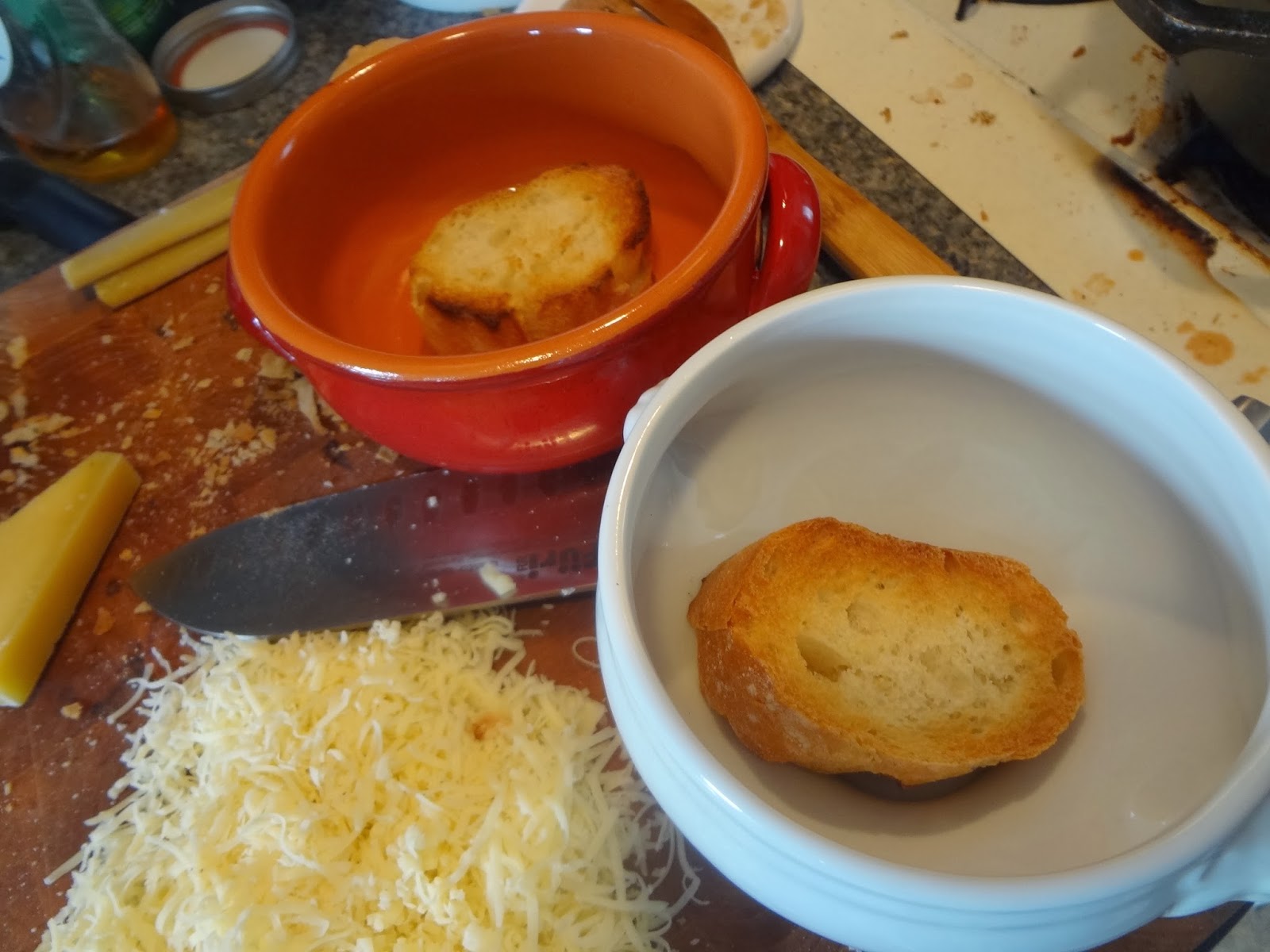
- place a crouton in the bottom of an oven-proof bowl and ladle the soup over it. Add another two croutons on top and smother in grated cheese (forgot to take a picture with the cheese, sorry!)

- melt the cheese under the broiler for a few minutes and look often! The croutons are very prone to burning... ahem...

- enjoy piping hot, with a nice glass of red wine!

Monday, November 4, 2013

Tarte Tatin (Upside down apple pie)

This famous French upside-down apple pie is not only delicious, but extremely easy to make! The best thing about it is that you cannot mess it up, because it already is "messed up" pie!

The legend says that one day, the Tatin sisters were busy cooking in their kitchen and one of the sisters forgot to put the dough before the apples in her pie. Realizing that she had started to bake a crust-less pie, she lay the crust on top of the apples mid-baking and turned it upside down to serve it :)

Serendipity right there if you ask me! The penicillin of desserts.

I am not a sweet tooth by any means, and would much rather end a meal on cheese. But put a warm slice of Tarte Tatin in front of me, with a dollop of cold creme fraiche (no vanilla ice-cream nonsense for me!), and I'll sell my soul to the Devil.

Here's how you can make this amazing and universally appreciated dessert.


INGREDIENTS:
- 1/2 quantity of pie crust (see a similar recipe here, just omit the lemon zest)
- 1/2 stick of butter
- 3/4 cup granulated sugar
- 6-8 apples, depending on their size and how packed you want the apple pattern to be when you turn it upside down (I ended up using 7 medium Honeycrisp apples; Golden delicious are good too)


RECIPE:
- preheat your oven at 375F
- on a lightly floured surface, roll out the dough to the size of the dish you will be baking the pie in

- in a cast iron skillet, melt the butter and sugar until frothy

Note: if you want your apples to come out a little darker, you can wait until the first stage of caramel, but do not overcook the caramel at this stage, since it will continue to cook in the oven and might result in a burnt-tasting bitter pie
- peel, core and half the apples, add them cut side up in the skillet and cover with the dough, making sure to tuck the extra bits!

- transfer the skillet to the oven and bake for 30-45 minutes, or until the crust is lightly golden

- let it cool a few minutes before turning the pie upside down on a serving plate

Note: mine was not as sticky as I would have liked it. The caramel was not thick enough for my taste and I should have let it cool down longer in the oven, turned off with the door propped open. It was still delicious though!
- serve warm, with a dollop of creme fraiche or sour cream on top


Heavenly.